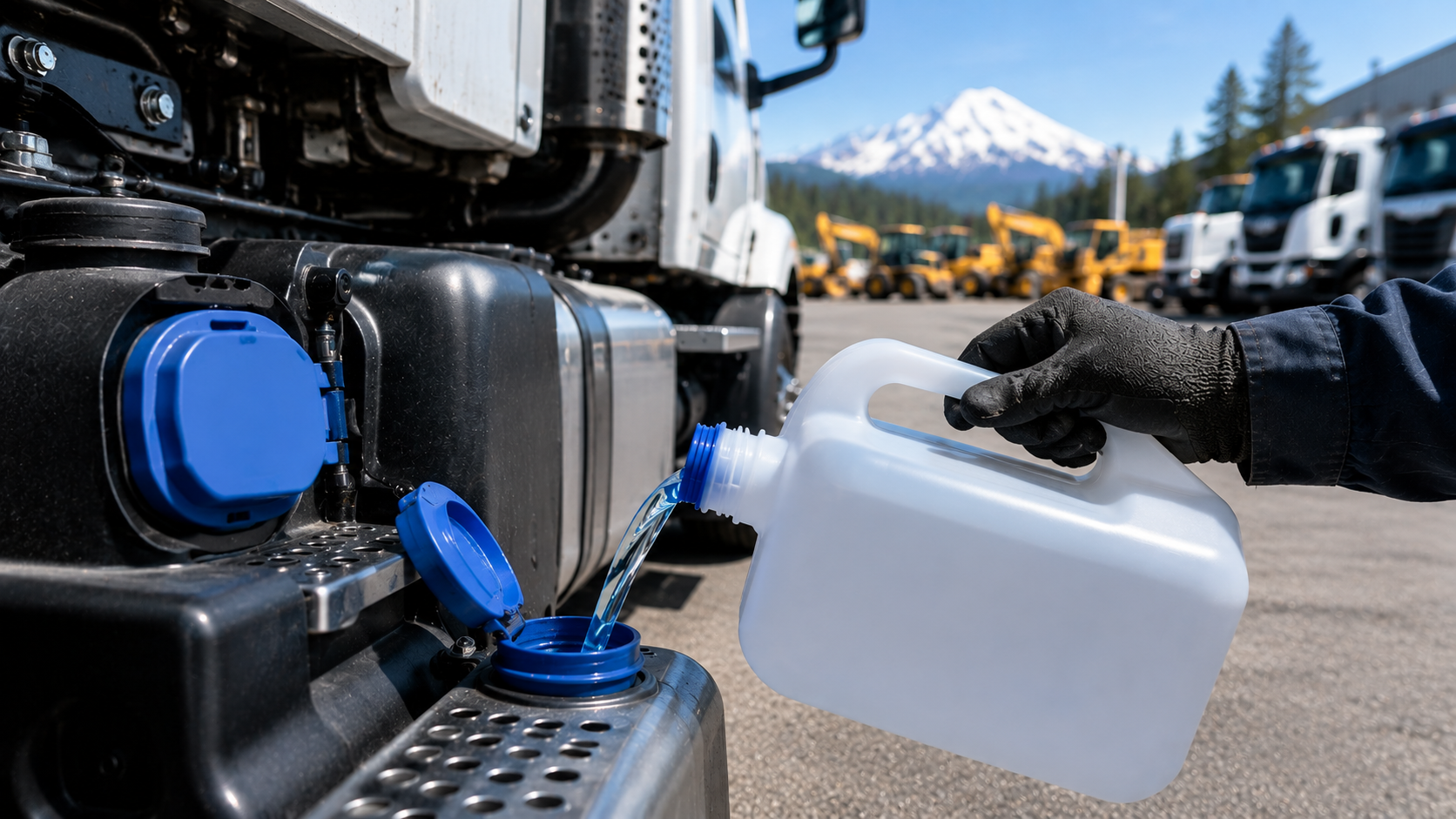
If you operate diesel-powered equipment manufactured after 2014, you’re already dealing with Diesel Exhaust Fluid — whether you fully understand it or not. DEF isn’t optional, it’s not a suggestion, and running your equipment without it will result in automatic shutdown. Here’s everything Washington equipment operators need to know.
Why DEF Exists: The Tier 4 Emissions Standards
In 2014, the EPA’s Tier 4 Final emissions standards took effect for off-road diesel equipment, requiring drastic reductions in nitrogen oxide (NOx) and particulate emissions. Equipment manufacturers — including Caterpillar, John Deere, Komatsu, Volvo, and others — responded by adopting Selective Catalytic Reduction (SCR) technology, which uses DEF to chemically convert harmful NOx into harmless nitrogen and water vapor in the exhaust stream.
The result: virtually all diesel construction equipment, agricultural machinery, and generators manufactured from 2014 onward require DEF to operate legally and efficiently. This includes the excavators, bulldozers, skid steers, and generators powering Washington’s massive construction boom.
What DEF Actually Is
Diesel Exhaust Fluid is a precise mixture of 32.5% high-purity urea and 67.5% deionized water. It must meet ISO 22241-1 standards — this is important because off-spec DEF can damage your SCR system, causing injector clogging and catalyst degradation that results in expensive repairs. Never use agricultural urea as a substitute; it is not formulated to the correct concentration and will damage your system.
Storage and Handling in Washington’s Heat
DEF has specific storage requirements that Washington’s climate makes particularly challenging. The fluid should be stored between 12°F and 86°F. In Washington, where outdoor temperatures regularly exceed 90°F and storage areas can reach 110°F+, proper storage is critical. Prolonged exposure to heat accelerates DEF degradation and reduces its shelf life below the standard one year.
Best practices for Washington operators: store DEF in a shaded, ventilated area, avoid direct sunlight on storage containers, use bulk or tote quantities that will be consumed within 6 months in summer conditions, and keep containers sealed to prevent contamination and evaporation.
What Happens When DEF Runs Out
Modern Tier 4 equipment has a tiered warning and shutdown system. As DEF levels drop, the machine will first display a warning on the dashboard. As levels continue to drop, it will limit engine performance. When DEF is completely depleted, the engine will restrict speed to a crawl — typically 5 mph — until DEF is replenished. There is no override. You cannot “work through it.” Your machine stops.
On a busy job site in Washington, a DEF-empty machine can shut down an entire crew and create costly delays. The solution is treating DEF inventory with the same seriousness as diesel fuel.
Evergreen Fuel’s DEF Delivery Options
Evergreen Fuel & Lubes supplies DEF in multiple formats to match your operation: drums (55-gallon), totes (275 or 330-gallon), and bulk delivery for high-volume users. We can bundle DEF delivery with your diesel delivery so both arrive on the same schedule, simplifying your logistics.
Learn about our DEF supply and delivery service or request a quote for your operation.